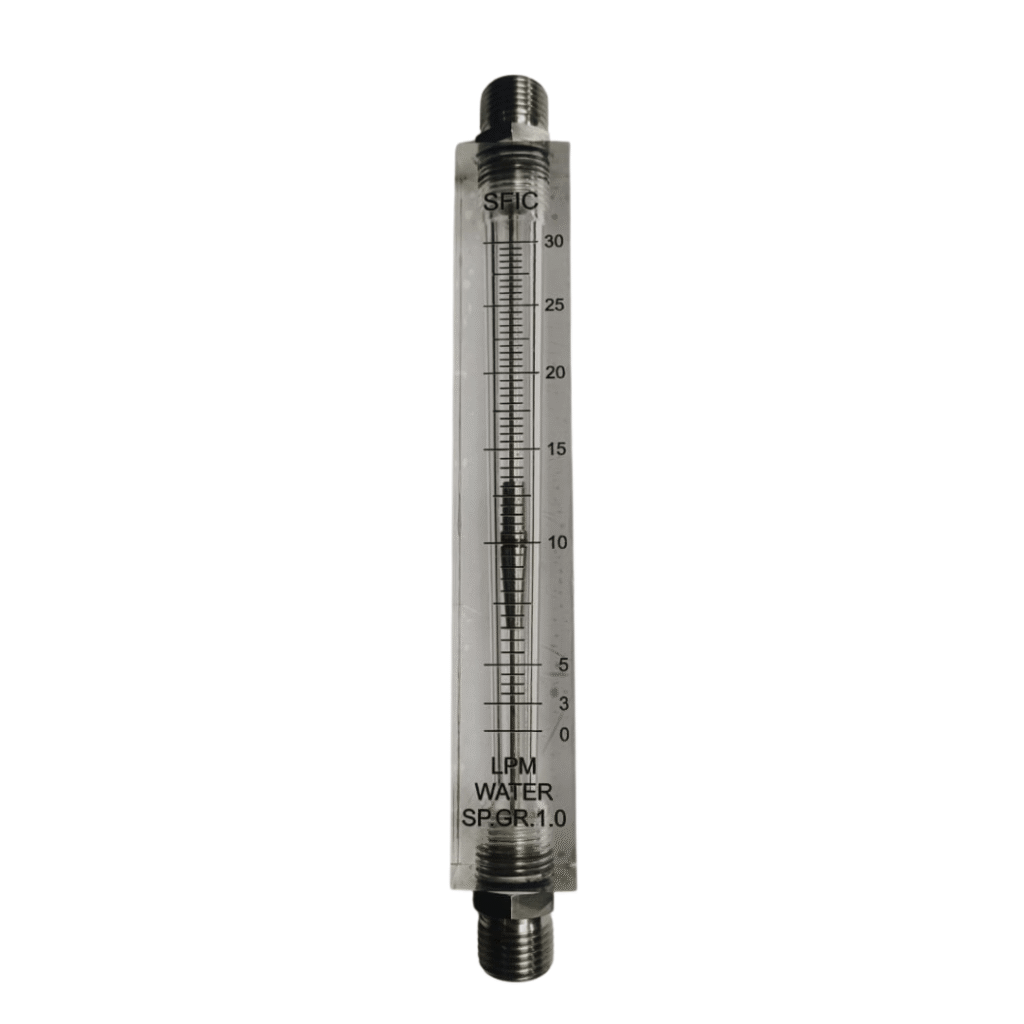
An Acrylic Rotameter is a vertical flow meter consisting of:
- A tapered acrylic tube
- A float inside the tube that moves upward as flow increases
- A calibrated scale for direct flow reading
It operates on the variable area principle, where the cross-sectional area changes as the float moves, balancing the upward fluid force with the downward gravitational force. The float stabilizes at a position indicating the current flow rate on the scale.
Acrylic rotameters are preferred where glass is too fragile or weight reduction is needed without compromising visibility or measurement accuracy.
The working principle of an Acrylic Rotameter is the same as other variable area flow meters:
- The fluid flows upward through the tapered acrylic tube.
- The float rises until the forces balance — fluid drag (upward) equals gravity (downward).
- The flow rate is read directly from the calibrated scale alongside the tube.
Advantages of acrylic include impact resistance, lighter weight, and chemical compatibility with many non-aggressive fluids
Construction & Design Features
Sai Tech Flow’s Acrylic Rotameters are engineered for reliability and industrial durability.
Key Components:
- Tube Material: Transparent Acrylic (PMMA / Polymethyl Methacrylate)
- Float Material: Stainless Steel / PTFE / PVC (based on fluid compatibility)
- End Connections: Flanged & Threaded (BSP / NPT) – Sai Tech Standard
- Working Pressure: Up to 10 bar
- Operating Temperature: Up to 100°C
- Flow Scale: Engraved or printed scale for LPH, LPM, Nm³/hr, SCFH
- Optional Flow Control Valve: For precise manual flow adjustment
- Protective Guard: Metal enclosure optional for extra mechanical protection
Technical Specifications (Sai Tech Flow Standard)
Parameter | Specification |
Flow Medium | Liquid / Gas |
Tube Material | Transparent Acrylic |
Float Material | SS316 / PTFE / PVC |
Flow Range | 10 LPH to 10,000 LPH (Liquid) / 0.1 to 100 Nm³/hr (Gas) |
Pressure Rating | Up to 10 bar |
Temperature Range | Up to 100°C |
Connections | Flanged & Threaded (BSP/NPT) |
Mounting Orientation | Vertical — upward flow only |
Accuracy | ±2% FSD (approx.) |
Advantages of Acrylic Rotameter
- Lightweight and impact-resistant
- Cost-effective alternative to glass rotameters
- Direct visual indication
- Corrosion-resistant with appropriate float materials
- Easy installation and maintenance
- Optional control valve for flow regulation
- Ideal for laboratory, pilot plants, and low-to-medium flow industrial applications
Industrial Applications
Acrylic Rotameters are widely used in industries such as:
- Chemical & Petrochemical – For moderate pressure/temperature flow lines
- Water & Wastewater Treatment – For dosing and monitoring chemicals
- Laboratories & R&D – Lightweight, shatter-resistant for experiments
- Pharmaceutical & Biotech – For low-to-medium flow measurements
- Food & Beverage Processing – Non-corrosive, visible monitoring
- OEM & Skid-Based Systems – Easy integration and replacement
- Gas Lines – For inert or non-aggressive gases
Acrylic Rotameters are especially preferred where mechanical durability, lightweight design, and cost efficiency are important, without compromising visibility and accuracy.
Acrylic vs Glass Rotameter – Key Differences
Feature | Acrylic Rotameter | Glass Rotameter |
Tube Material | Acrylic (Impact Resistant) | Borosilicate Glass |
Cost | Lower | Moderate |
Temperature Limit | Up to 100°C | Up to 100°C |
Pressure Handling | Up to 10 bar | Up to 10 bar |
Weight | Light | Heavier |
Visibility | Good | Excellent |
Chemical Resistance | Medium (with PTFE / PVC float) | High (with SS/PTFE float) |
Conclusion: Acrylic rotameters are ideal for applications where fragility, weight, and cost are a concern, while glass rotameters are preferred for high clarity and purity monitoring.
About Sai Tech Flow – Trusted Indian Manufacturer
Sai Tech Flow is a leading manufacturer and supplier of industrial flow instruments in India. Our expertise includes rotameters, flow meters, flow indicators, and control devices. We deliver precision-engineered Acrylic Rotameters with calibration, durability, and industrial compliance, suitable for chemical, pharma, water treatment, and OEM applications.
Our products are supplied with flanged & threaded connections, optional control valves, corrosion-resistant floats, and are widely used across domestic and international markets